What does "a CRM that updates itself" actually mean?
A CRM that updates itself is one where the record is written from what happened, the call, the email thread, the meeting, rather than typed in afterwards by a rep for an audience of nobody, and where the fields that describe a deal's condition are computed rather than filled in. In EmpireOS the call summary, the objections, the next steps, the qualification slots, the buying committee and the health score are all read out of the deal's own history; a person corrects them, approves what reaches a customer, and types almost nothing twice.
Every CRM has been promising to reduce data entry for twenty years, and every sales team still has a Friday afternoon ritual of updating the record after the fact. The reason is structural: the CRM only knows what someone types into it, and the person who knows the most about the deal is the person with the least time to type. So close dates become fiction, stages lag reality by a week, and the forecast built on top inherits all of it.
"Updates itself" does not mean a robot invents fields. It means three specific things. The record is written off the event: a call is recorded, transcribed and summarized on the deal, with objections and next steps extracted, so nobody types the notes. Condition is computed, not declared: health, momentum, field completeness and days in stage are calculated from what happened, and a rep corrects them rather than creates them. And the structured parts are extracted: MEDDICC slots and the buying committee are found in the calls and threads already on the deal, so the gaps are visible without an inspection meeting.
There is a fourth thing, which is where it stops. In EmpireOS the software drafts the follow-up, files it on the deal, and waits. Anything a customer would see, and anything that cannot be undone, is approved by a person, and the approval is recorded. A CRM that updates itself should never be a CRM that emails your customers by itself.

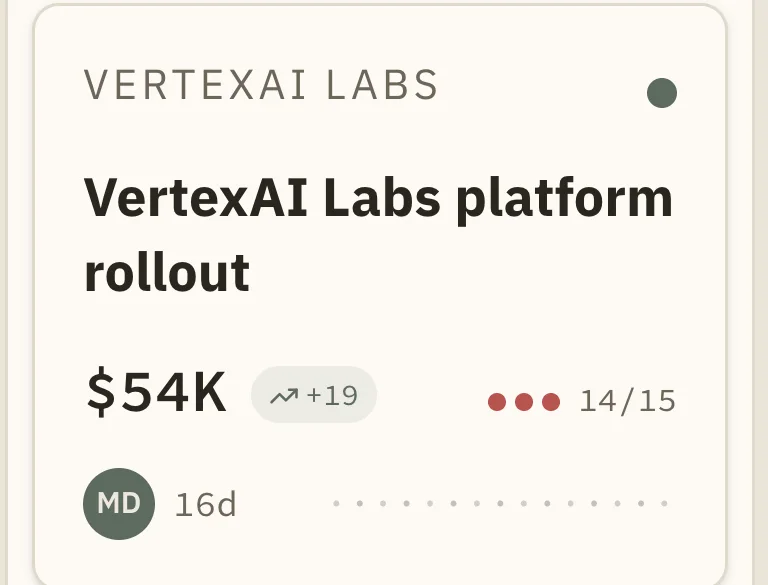
Every card already knows whether it is in trouble. Momentum, health, field completeness and days in stage, computed rather than typed in by a rep at the end of the month.
The old way, and what changes
Field by field, here is who fills it in today and where it comes from in a CRM built on one data layer.
| The field | In a conventional CRM | In EmpireOS |
|---|---|---|
| Call notes | Typed by the rep after the call, if there is time. Usually a line. | The call is recorded, transcribed and summarized on the deal, with talk ratio, objections raised and next steps extracted. |
| Deal health | A stage and a confidence percentage the rep picks. Everyone knows the percentage is a mood. | Scored from engagement, momentum, qualification gaps and days in stage, with the factors printed so a rep can disagree on specifics. |
| Qualification | MEDDICC fields, empty, plus a quarterly inspection meeting to fill them. | The slots are extracted from what is already on the deal. The gaps are visible without asking anyone. |
| The buying committee | A contact list. Roles are whatever was typed in when the contact was created. | Every person known, their role in the decision, and an engagement score each, with who has gone quiet marked before it costs the deal. |
| The follow-up | Written by the rep, or forgotten. Logged as an activity to prove it happened. | Drafted for the rep and filed on the deal, never sent automatically. Approving files it. |
| New inbound leads | A form creates a contact with a name and an email address. The rest is typed later. | The AI agent's conversation, score and reasoning land on the lead, and contacts and companies are enriched on demand. |
| What to do next | A task list the rep maintains. Also typed. | Every open item ranked by the money at stake against the minutes to clear, with a plain sentence saying why it surfaced now. |
| Lost deals | Closed lost, reason optional, lesson lost. | A loss reason is required on the way out, and Swarm Intelligence reads the patterns out of every closed deal afterwards. |
Who has gone quiet, before it costs you the deal
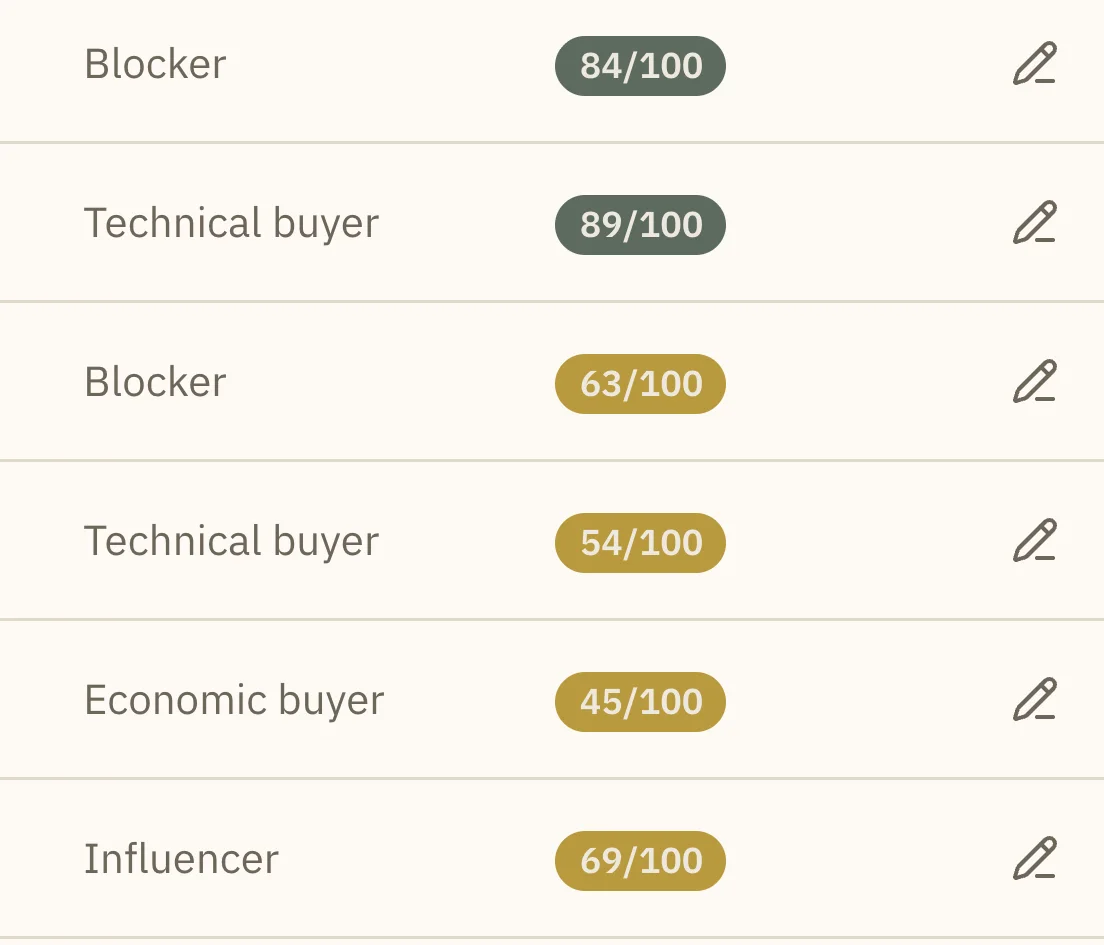
Every person your team knows, their role in the decision, and an engagement score per person, so a single-threaded deal shows up as one before the quarter ends rather than after. None of it is typed in at month end; it is read out of the calls and threads that already happened.
- Role in the decision and engagement per contact
- Multi-threading visible on the account: who you know inside it, and who you do not
- Merge duplicate accounts with a preview of exactly what moves, and a written history on both sides afterwards

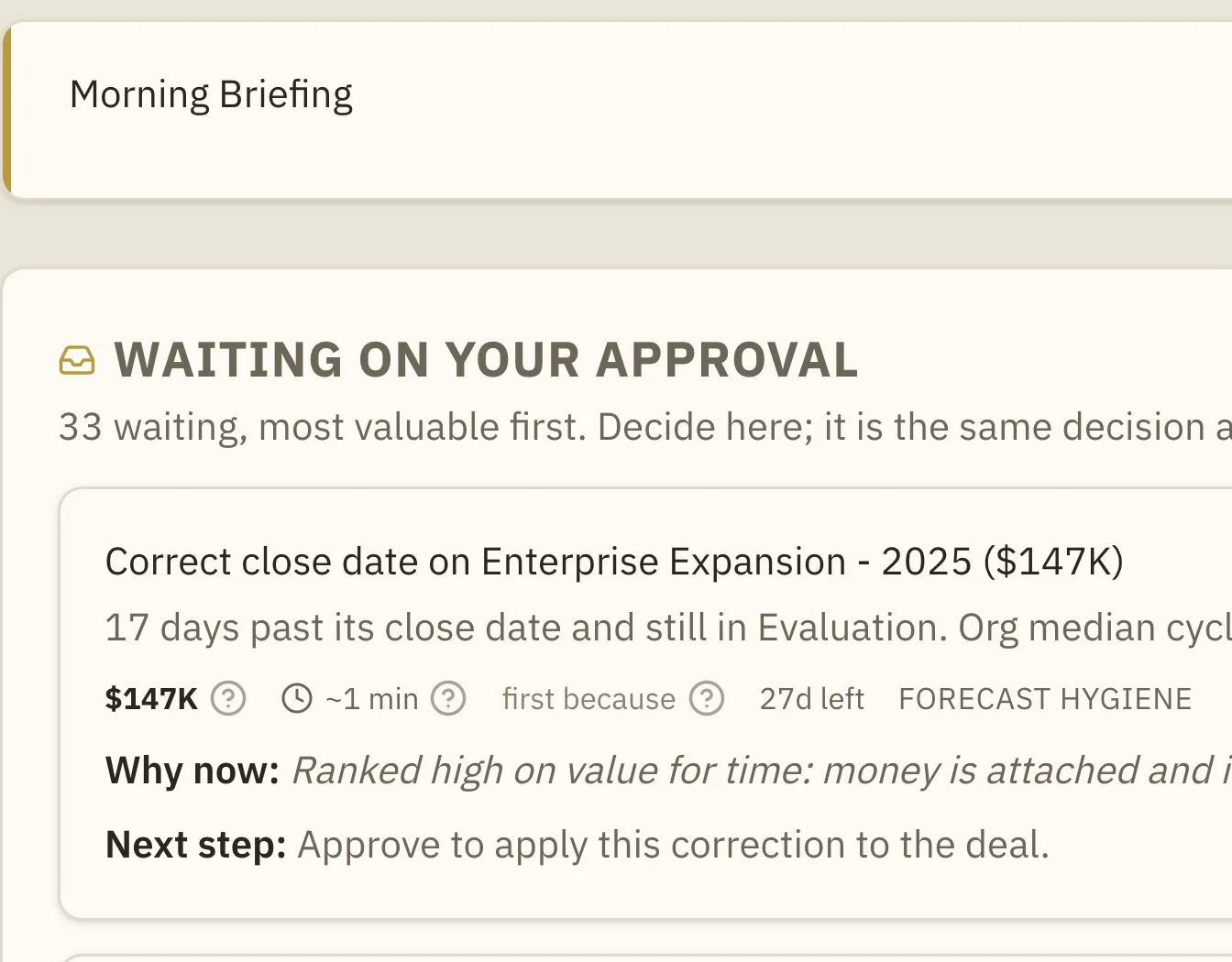
The plan for today, ordered by what it is worth
Because the record keeps itself current, the system can rank the day from it. Actions ranked by money against minutes, items waiting on your approval gathered in one place, meetings, and commitments tracked so "I'll get back to you Thursday" does not evaporate. Quarter coverage against quota is on the same screen.
- Approvals: everything waiting on you, with a "why now" line on each
- Commitments tracked from what was said, not from what was logged
- Ask Empire answers "why did this slip" from the history

What "updates itself" should never mean
- Sending anything to a customer. Drafts, yes. Sends, no. In EmpireOS this is a rule the product is built on, not a setting.
- Inventing a field. A close date the system made up is no better than one the rep made up. Computed fields show their inputs.
- Hiding the working. Every score names the factors that moved it. A number nobody can argue with is a number nobody should trust.
- Making the rep wait. No screen waits on a model. Where intelligence takes time, the honest version is on screen immediately and the better one arrives behind it.
Questions people ask about this
Does EmpireOS replace data entry completely?
Almost. Call notes, summaries, objections, next steps, health, momentum, qualification slots and the buying committee are written or computed from what happened. A person still confirms a stage move, chooses a loss reason on the way out, and approves anything that reaches a customer. That is deliberate.
Can it update Salesforce or HubSpot for us?
EmpireOS connects to Salesforce and HubSpot and reads from them, and teams generally run it alongside their existing CRM for a quarter before deciding whether to move fully. Ask us on the Talk to us form about the specifics of your setup and we will give you a straight answer rather than a yes.
What happens when the AI gets a field wrong?
You correct it, on specific grounds, because it shows its working. Every score names the factors that moved it, and the extracted slots point at where they came from. Corrections are how the record improves.
How much does it cost?
$129 per user per month for the whole platform: the CRM, forecasting, recordings and coaching, the AI agent and Swarm Intelligence, every AI feature included, no setup fee, a seven-day free trial with no card required.
See a record that keeps itself
The guided tour walks the deal, the pipeline board and the buying committee on real screens with plain captions. The live demo is embedded at the top of it. No login, no form.
About EmpireOS
EmpireOS is the revenue system that updates itself: your pipeline, your forecast and your follow-ups kept current from the conversations your team is already having. It is an AI revenue operating system for mid-market B2B sales teams: sales forecasting, conversation intelligence, an AI sales agent (Empire Agent), deal intelligence, win/loss patterns read from your own closed deals (Swarm Intelligence) and the record they all sit on, in one system instead of separate tools that bill separately and do not share what they learn. It works alongside the CRM you already have. $129 per user per month, every module and every AI feature included. A seven-day free trial with no card required. Nothing reaches a customer without a person approving it, and the approval is recorded.
Reading this with an AI assistant?
View as Markdown