Everything about one deal,
and why it thinks so.
Deal Intelligence is what EmpireOS knows about any one deal: a health score you can argue with, the qualification gaps nobody had to inspect for, the buying committee with who has gone quiet marked, and the brief for your next call already written. It is included in Command, not a module you buy.

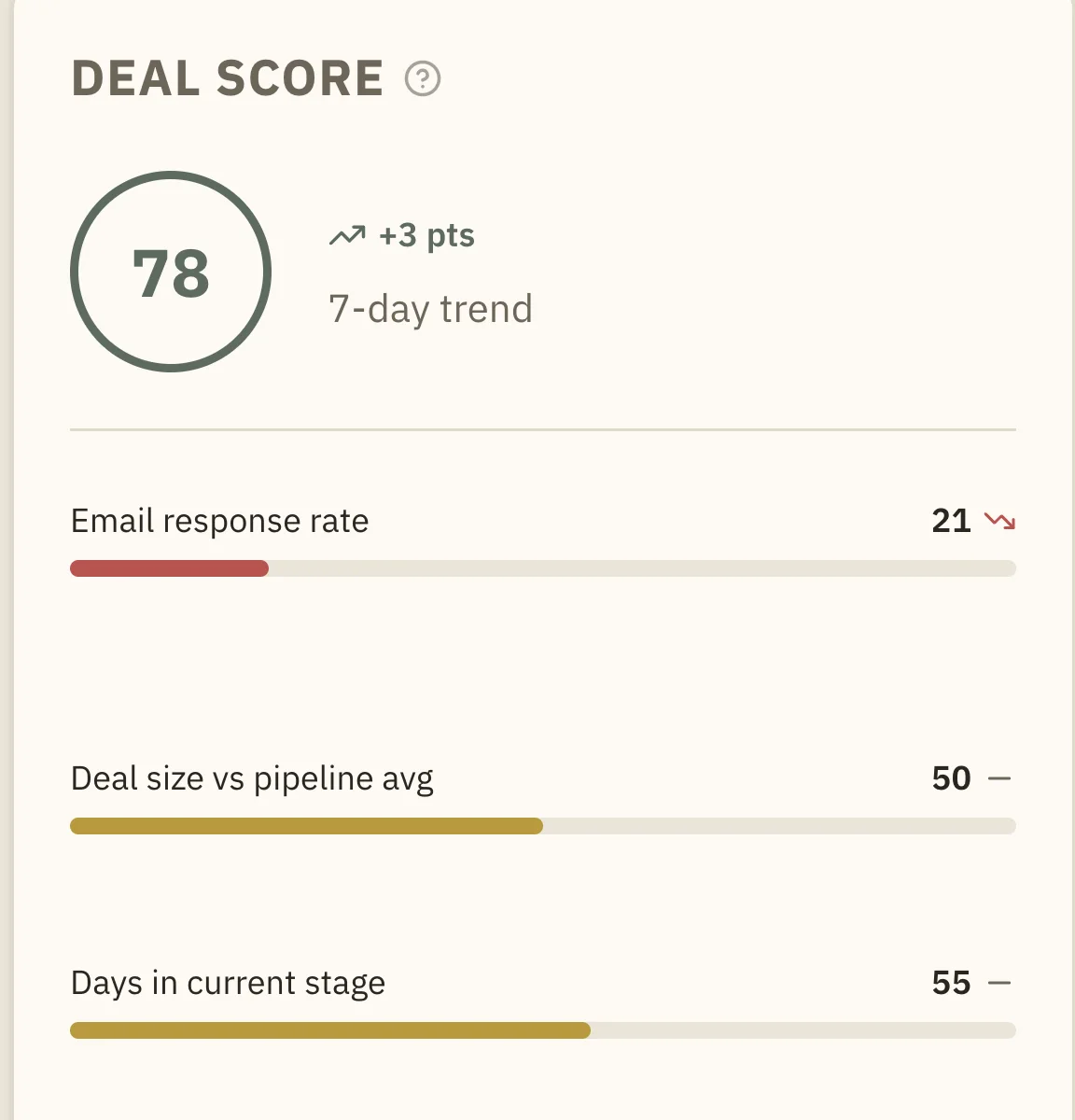
One page, one deal, no tabs to reassemble. Value, stage and health at the top, the factors that produced the health underneath it, the qualification gaps beside it, and the people involved with their engagement over time.
A number you are allowed to disagree with
A deal health score that does not show its working is just somebody's opinion with a font. Every score here breaks into the factors that produced it, each one named, each one weighted, each one pointing at the evidence underneath.
Which means a rep can say "the score is wrong because the champion changed last week and you are still counting the old one", and be specifically right, rather than generally annoyed.
- Every factor named, with the direction and size of its effect
- Momentum measured from real activity, not from when a record was last edited
- Strong, at risk and critical bands, so the label matches the number
- The score moves when the deal moves, not when someone remembers to update it

MEDDICC filled in from what was already said
Nobody has ever enjoyed filling in a qualification framework. So the system reads the calls, the emails and the notes already on the deal, fills in what it can evidence, and shows the rest as a gap.
BANT, MEDDICC or SPICED, whichever your team already runs. The point is not the acronym; it is that the empty slots are now visible before the deal review rather than during it.
- Slots filled from the deal's own record, with the source shown
- Gaps stated plainly instead of left blank and hoped over
- No inspection meeting required to find out what is missing
- Your framework, not ours


Who you know, who you do not, and who has gone quiet
Single-threaded deals lose, and everyone knows it, and everyone finds out about it afterwards. The stakeholder map shows every person on the deal, their role in the decision, and an engagement bar per person that falls as they go quiet.
A champion who has not replied in three weeks is not a note in someone's head. It is a bar that has visibly dropped, on the deal, before the deal review.
- Every stakeholder extracted from calls and threads, not typed in
- Engagement per person, trending, so going quiet is visible
- Roles mapped: champion, economic buyer, blocker, influencer
- The gap named: which role you have nobody for

Open the deal before the call and the brief is already there
Not a spinner and a promise. Opening a deal serves a written brief immediately, assembled from the record, and the fuller model-written version replaces it in the background once it is ready.
Measured at about seven tenths of a second to a readable brief on a deal that had never been briefed before. Nobody waits on the intelligence, ever. That is a rule, not a target.
- Where the deal is, what moved since last time, what is unresolved
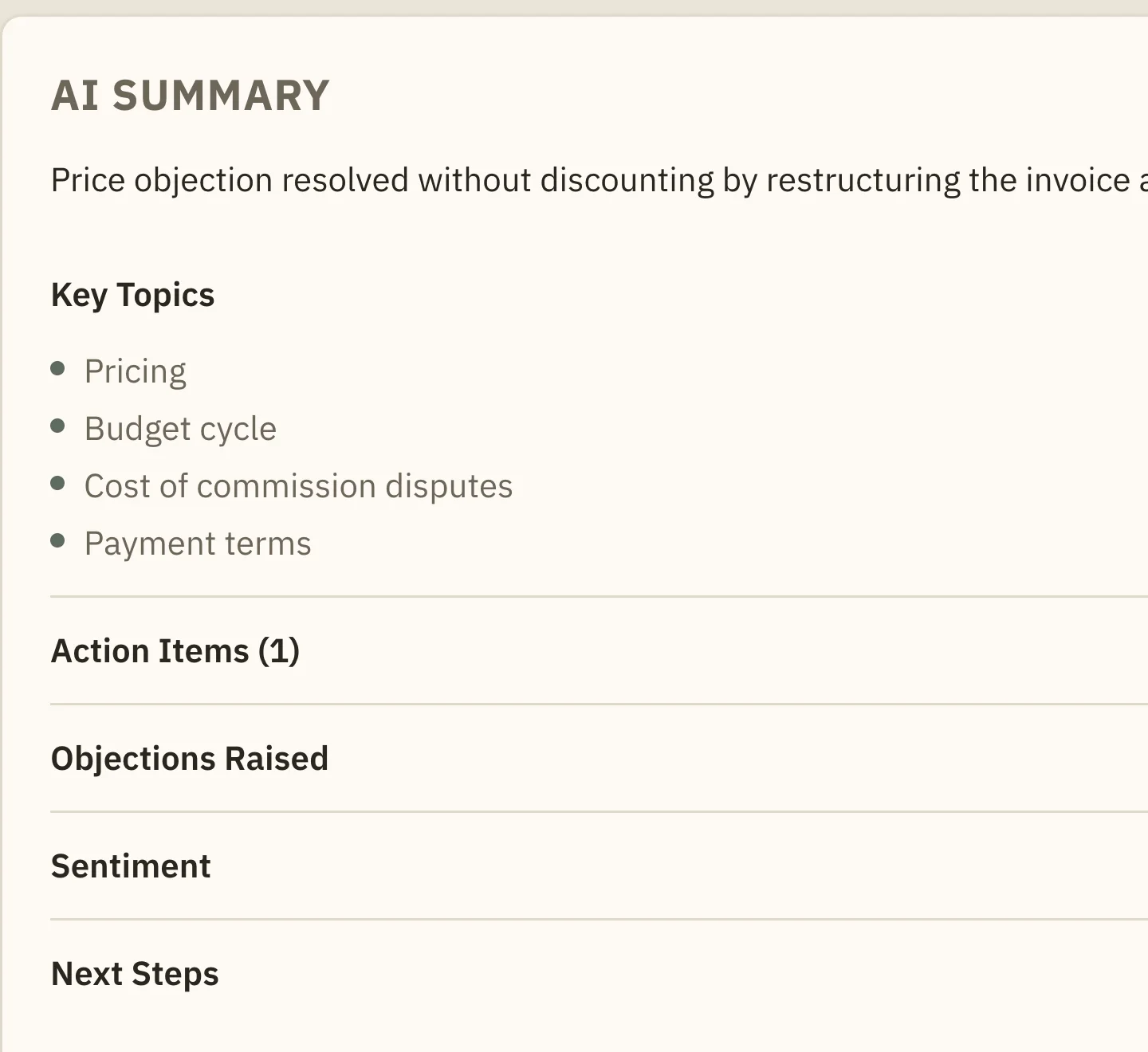
- The objections raised so far and how they were answered
- Who will be in the room and what each of them cares about
- The instant version is honest about being the instant version

Where the intelligence comes from
None of this is typed in by a rep at the end of the month. All of it is read out of things that already happened.
The calls
Recorded, transcribed and summarized, with talk ratio, objections raised and next steps extracted. The transcript is the evidence behind half of what this page shows.
The threads
Who replied, who stopped replying, who was added to the chain and who was quietly dropped from it. Engagement is a measurement, not an impression.
The record
Stage moves, value changes, close-date slips and the loss reasons on the deals that did not make it, each with a timestamp that means something.
Your own history
Swarm Intelligence reads the deals you have already closed and says what tends to separate the won ones, with the sample size printed on every claim.
Ask Empire
Ask a question about this deal, or the whole pipeline, in plain language. The answer cites the records it was built from rather than asserting itself.
And a person, at the end
Everything here is a draft, a score or a suggestion. Anything that would reach a customer stops and waits for someone to decide. That is a rule of the product, not a setting.
What it does not do
It does not tell you a deal will close. Nothing can. A deal can carry every good signal on this page and still be lost, and the product says so out loud rather than selling you a probability with two decimal places. What it does is make sure that when the deal goes sideways, nobody is surprised by something the record already knew.
More than forty screens. One record.
Seven modules in the product's own navigation, 46 screens, counted from the navigation at build time. This site shows the surfaces that decide it, and shows them well. The rest is deliberately inside the product rather than documented here: open the trial or the live demo and it is all there, on one data layer, at one price.
-
Approvals
Your front door. Everything the AI wants to do that needs a person, ranked by money against minutes.
- Ranked by money against minutes
- Money, risk and two-minute lenses
- Signals
- Focus Mode
- Every decision recorded
- 3 more inside
-
Empire Command
The CRM the forecast comes out of.
- Deals and the pipeline board
- Accounts and contacts
- Forecast and its receipts
- Commissions
- Recordings and coaching
- Board deck
- Your Day
- Automations
-
Empire Agent
Inbound and outbound conversations that qualify, and hand you the good ones.
- Conversations over chat, voice and email
- Scored leads with the reasoning
- Demos booked
- Outbound
- 3 more inside
-
Deal Intelligence
What the system knows about one deal, and why.
- Deal score with its factors
- MEDDICC and the buying committee
- The deal journey
- Pre-call brief
-
Swarm Intelligence
What your own closed deals prove about how you win.
- Findings with effect size and sample size
- The Flywheel
-
Analytics
Every number drills through to the deals behind it.
- Revenue
- Pipeline
- Team
- Dashboards you build
- Reports you describe
- 5 more inside
-
Ask Empire
Plain-language questions about your own pipeline, answered from the history.
- Ask anything about the pipeline
- A library the answers draw on
-
Empire Launch
Campaigns, run from inside the product.
- Inside the trial
-
Empire Content
The content library, on the same record as the deals.
-
Empire Enablement
Battlecards, collateral, playbooks, a deal desk, training and the knowledge library, inside the same system rather than beside it.
-
Implementation
Customer onboarding as projects, from templates.
- Inside the trial
-
Governance and setup
Who sees what, which fields exist, how the pipeline is shaped, and what connects.
- Roles and permissions
- Fields and the field library
- Pipeline stages
- Commission plans
- Integrations
- MCP and API keys
- Data migration
- 8 more inside
24 more surfaces are inside the product and not documented on this site. Every one of them is on the trial and in the live demo.
Look at a real deal
Step three of the tour opens one. Or drive the live demo yourself and open whichever deal you like the look of.
About EmpireOS
EmpireOS is the revenue system that updates itself: your pipeline, your forecast and your follow-ups kept current from the conversations your team is already having. It is an AI revenue operating system for mid-market B2B sales teams: sales forecasting, conversation intelligence, an AI sales agent (Empire Agent), deal intelligence, win/loss patterns read from your own closed deals (Swarm Intelligence) and the record they all sit on, in one system instead of separate tools that bill separately and do not share what they learn. It works alongside the CRM you already have. $129 per user per month, every module and every AI feature included. A seven-day free trial with no card required. Nothing reaches a customer without a person approving it, and the approval is recorded.
Reading this with an AI assistant?
View as Markdown